
What is the Secret to Playing Blackjack in a Real Casino?
Playing blackjack in a real casino requires balancing unshakeable mathematical basic strategy with strict physical table etiquette. To protect your bankroll against dealer house edges, you must:
- 1. Never touch cash to dealer's hands (place on felt).
- 2. Avoid 6:5 tables—only play 3:2 payout felts.
- 3. Use non-verbal hand signals for eye-in-the-sky cameras.
- 4. Never take Insurance or Even Money wagers.
- 5. Avoid Continuous Shuffling Machines (CSMs).
- 6. Never touch your cards in face-up shoe games.
1. Exposed: The Real Tricks Casino Dealers Use
Why casinos never rely on luck—and how dealers exploit player human psychology.
Contrary to popular Hollywood myth, licensed casino dealers in Las Vegas, Reno, or London do not palm cards or perform sleight-of-hand card stacking under overhead 4K surveillance. Instead, the real "tricks" dealers and casinos use are psychological, structural, and mathematical pacing traps designed to quietly extract maximum profit from inexperienced visitors.
Trick 1: Rapid-Fire Deal Pacing
Dealers are trained to deal between 200 and 350 hands per hour on empty or fast tables. Because the casino holds a mathematical edge on every hand, accelerating the number of rounds per hour exposes your bankroll to the house edge at triple velocity, causing rapid bankroll burnout before you realize it.
Trick 2: The "Even Money" Generosity Trap
When you get a Natural Blackjack (21) and the dealer shows an Ace, they will warmly ask: "Even money, sir? Lock in a guaranteed win!" It sounds like friendly protection, but it’s mathematically terrible: taking 1:1 gives up your expected value of 3:2 (1.5x) where the dealer will fail to have a blackjack roughly 69.2% of the time!
Trick 3: Continuous Shuffling Machines (CSMs)
Rather than dealing out a standard 6-deck plastic shoe and pausing to shuffle, many modern tables feed discarded cards straight back into a continuous tumbler after every round. This eliminates deck penetration, nullifies card counting entirely, and pumps hand volume up by 25%.
Trick 4: The 6:5 Payout Disguise
Casinos place low-limit tables ($5–$15) right near the entrance doors with bright neon signage, but quietly stamp the felt with "Blackjack Pays 6 to 5" instead of 3 to 2. On a $10 bet, you receive $12 instead of $15. This increases the casino’s edge by a crippling +1.39%!
Comparison Matrix: Dangerous Table Traps vs. Player-Favorable Rules
Before putting a single chip on the felt, verify these exact casino table parameters:
| Table Parameter | 🚨 Dangerous Trap (Avoid) | ✅ Pro Standard (Play Here) | House Edge Swing |
|---|---|---|---|
| Blackjack Payout | 6 to 5 (or 1:1) | 3 to 2 Payout | +1.39% for House |
| Dealer Soft 17 | Dealer HITS Soft 17 (H17) | Dealer STANDS on all 17s (S17) | +0.22% for House |
| Double After Split (DAS) | Not Allowed | Allowed on any two cards | +0.14% for House |
| Surrender Option | No Surrender | Late Surrender Allowed | +0.08% for House |
| Shuffling System | Continuous Shuffler (CSM) | Manual Shoe / Batch Shuffler | +25% Hand Volume Exposure |
2. Step-by-Step: How to Walk Up and Play Like a Seasoned Pro
Zero embarrassment. Master the exact physical rituals expected in elite casino pits.
Step 1: The Buy-In (The "No-Touch" Cash Rule)
Never hand cash directly into a dealer's hands—they are strictly prohibited from touching it. Wait until the current hand is finished, then lay your cash flat on the felt in front of you. The dealer will smooth out each bill, declare the amount aloud to the pit boss (e.g. "Changing one hundred!"), and slide an orderly stack of colored chips back to you.
Step 2: Placing Bets and Chip Stacking
Place your wager directly in the marked circle or square. If betting multiple chip denominations, always place the highest denomination chip at the bottom of your stack, with smaller chips on top. Once the first card leaves the shoe, never touch your bet under any circumstances until the dealer settles the hand.
Step 3: Flawless Hand Signals for Surveillance
In modern shoe games (where cards are dealt face up), you must never touch your cards. Overhead security cameras cannot hear you speak, so all choices require explicit hand signals:
Step 4: Cashing Out & "Coloring Up"
When you're ready to leave, do not take dozens of small $1 or $5 chips to the cashier cage. Between hands, slide your chips into the center and tell the dealer: "Color up, please." The dealer will exchange your pile for clean, high-value black ($100) or purple ($500) chips, keeping cage queues short and dealer trays balanced.
Master the Physical Basic Strategy Matrix
Did you know casinos legally allow you to bring a physical laminated strategy card to the table? As long as you don't slow down the game or place the card directly on the betting felt, you can consult it on every hand.
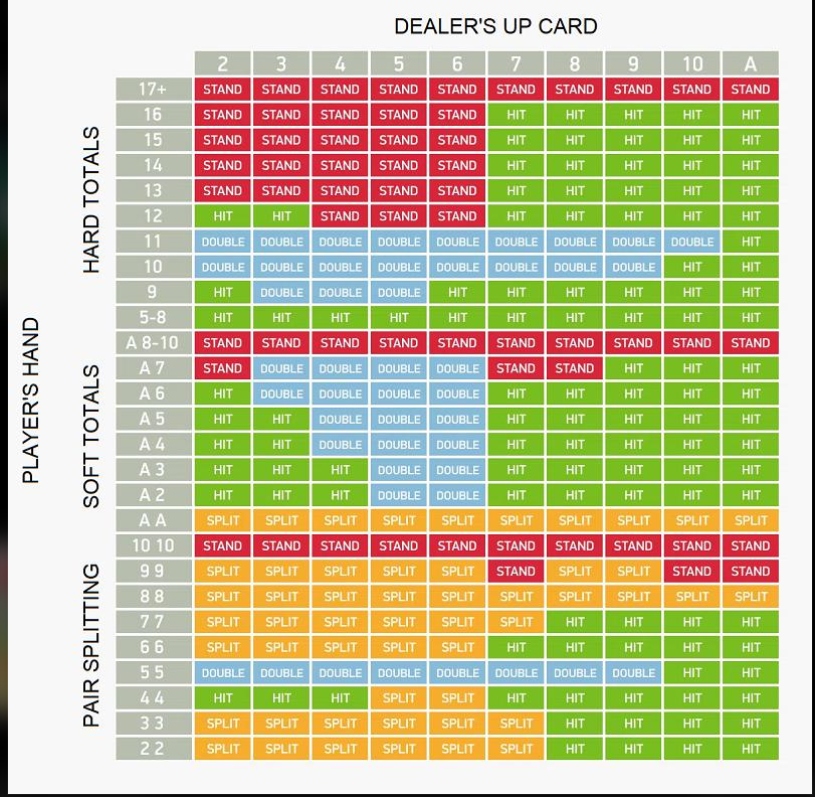
The 4 Golden Rules You Must Memorize:
- 1.Always Split Aces & 8s: Splitting Aces gives you two shots at 21; splitting 8s breaks up a dreaded 16 (the worst total in blackjack).
- 2.Never Split 10s or 5s: A pair of 10s is a winning 20. A pair of 5s should be treated as a hard 10 and doubled down.
- 3.Double Down on 11 vs 2–10: 11 is your supreme offensive weapon. Take one extra card and press your advantage.
- 4.Stand on 12–16 vs Dealer 2–6: Let the dealer take the risk of busting when they show a weak upcard.
Dealer Etiquette, Tipping & The "Third Base" Myth
Busting the "Third Base Ruined My Hand" Myth
In brick-and-mortar casinos, angry players often yell at the player in seat 7 (Third Base—the final player to act) if they hit and take a 10 that would have caused the dealer to bust.This is mathematically false. In an uncounted shoe, the cards dealt to third base are statistically independent. Over thousands of hands, a beginner at third base is just as likely to save the table as hurt it. Ignore table superstitions and play your correct basic strategy card.
How and When to Tip the Dealer
Dealers earn minimum wage and rely on tips for 70%+ of their income. A happy dealer makes the game friendlier and won't rush your decisions. Instead of handing the dealer a chip, place a $1 or $5 chip on the outside edge of your betting circle right before the deal. If your hand wins, the dealer's bet also wins 1:1, doubling their tip. They will root for your success!
Pit Boss Ratings & Player Rewards Cards
Always present your Casino Rewards Card when buying in. The pit supervisor enters your average bet and hours played. Even if you break even or lose a modest amount, your table action can earn free buffet vouchers, hotel room comps, and VIP line passes.
3. The 4-Hour Casino Session Bankroll Formula (Risk of Ruin Prevention)
Walking into a casino without a defined mathematical betting unit is the #1 reason 90% of tourists leave broke within 45 minutes. Here is how professional blackjack analysts calculate session bankroll allocation:
$300 – $450 Bankroll
Represents 25 to 30 betting units. Protects against standard negative standard deviation streaks where the dealer draws 5 pat hands in a row.
$1,000 – $1,500 Bankroll
Allows proper split-and-double leverage. If dealt an 8-8 split that turns into two double downs, you need 4x your base bet on a single round without fear.
$3,000 – $5,000 Bankroll
Played in private salons with 3:2 payouts, Stand on Soft 17 (S17), and deep deck penetration. Demands iron-clad emotional discipline.
Standard Casino Chip Color Hierarchy (Know What You Are Holding):
4. Understanding Casino Shift Changes & The 20-Minute Dealer Rotation
In physical casinos, dealers do not sit at the same table for hours on end. Casino regulatory standards mandate a strict dealer rotation every 20 or 40 minutes. Understanding why this happens gives you a major strategic edge:
- Combating Dealer Fatigue: Dealing repetitive math under bright LED lights causes mental exhaustion. Fresh dealers maintain speed and vigilance.
- Breaking "Lucky" Streaks: While casino managers know cards are random, superstitious players believe in hot and cold dealers. Bringing in a new dealer changes table psychology immediately.
- Preventing Dealer-Player Collusion: Rotating dealers prevents a rogue dealer from quietly helping friendly players or overlooking short bets over prolonged periods.
Real Casino Blackjack FAQ (Quick Answers)
Can I use my phone at the casino blackjack table?
No. Physical casinos strictly forbid phones being held or placed on the table felt while cards are in play. Step away from the chair if you need to take a call or send a text.
What happens if I make a mistake with a hand signal?
If there is any ambiguity, the dealer will pause and ask for clarification, or call the pit boss over to review camera footage. The camera tape always overrides whatever was spoken aloud.
How much money should I bring for a $15 table?
To withstand normal standard variance, you need roughly 20 to 30 betting units. For a $15 minimum table, bring a session bankroll of at least $300 to $450 to avoid getting wiped out during a standard short-term statistical downswing.
How can I practice before heading into a real casino?
Use our realistic 3D WebGL Blackjack simulator right here in your browser. It enforces authentic Las Vegas 3:2 rules, dealer voice calls, and standard timing with zero monetary risk.
Master Table Mechanics Before You Risk Real Cash
Sharpen your instincts against our 3D dealer. Drill splits, double downs, and dealer stands in a zero-risk 60 FPS simulator.