
Blackjack Basic Strategy
The definitive mathematical cheat sheet and decision matrix to eradicate the house advantage.
Built from billions of Monte Carlo computer simulations: explore the exact mathematical decisions for hard totals, soft hands, and pair splits to slash the casino's statistical margin down to an absolute baseline of 0.36%.
What Is Blackjack Basic Strategy and How Does It Work?
Blackjack basic strategy is an algorithmically optimized matrix that dictates the exact decision (Hit, Stand, Double Down, Split, or Surrender) for every possible player hand versus dealer upcard combination. It was initially formulated by Dr. Julian Braun and Edward O. Thorp using IBM mainframe computers to calculate the highest statistical expected value (+EV) across billions of simulated hands.
Without basic strategy, an emotional player gives the casino a 2.0% to 4.0% house advantage. Executing flawless basic strategy compresses the casino edge down to just 0.36% to 0.50%, virtually eliminating the casino's mathematical margin on 3:2 payout tables.
Official Basic Strategy Cheat Sheet Chart
The high-resolution master grid covering 4-deck to 8-deck shoes with dealer standing on 17.
Multi-Deck Basic Strategy Engine (S17 • DAS)
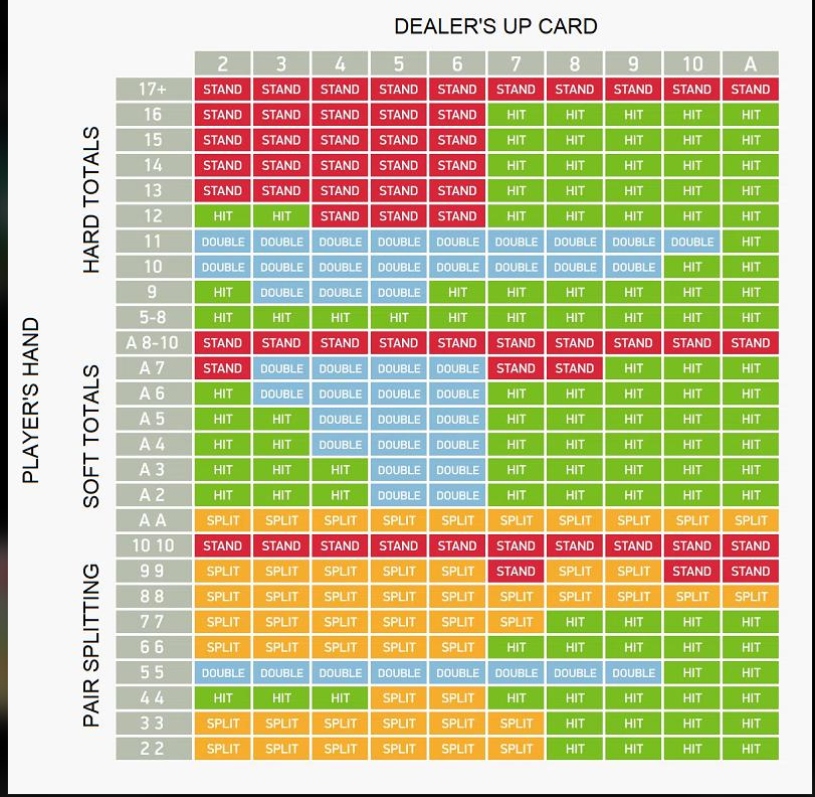
Master Table Instructions: Locate your current hand in the vertical column on the left (Hard Totals, Soft Totals, or Pairs). Cross-reference with the dealer's face-up card along the top row (2 through Ace). Execute the exact color-coded action.
Hard Totals: The 12–16 Stiff Dilemma
Why standing on weak totals against bust upcards is mathematically mandatory.
1. The Stiff Hand Rule: Totals 12 through 16
A Hard 16 (e.g. 10-6) is statistically the worst hand in blackjack. If you take a hit, drawing any 6, 7, 8, 9, 10, Jack, Queen, or King (30+ cards) results in an immediate, irrevocable bust.
Exploiting the Dealer's Mandatory Draw
When the dealer displays an upcard of 4, 5, or 6, their mandatory drawing rules force them to hit their stiff hands, leading to a dealer bust rate between 35% and 42%. By Standing on 12 through 16, you preserve your chip stack and let the house take 100% of the bust risk.
2. Aggressive Doubling on 10 and 11
Totals of 10 and 11 represent your greatest mathematical scoring opportunities. Because nearly one-third of the deck (16 out of 52 cards) consists of 10-value cards, doubling down provides an enormous statistical surge:
Hard 11: Double Down Always
Against any dealer upcard from 2 through 10, always double down. On S17 tables, double 11 even against a dealer Ace.Hard 10: Double vs. 2 through 9
Double down against any dealer upcard of 2 through 9. Simply hit against a dealer 10 or Ace.Hard 9: Double vs. 3 through 6
Double down when the dealer is weakest (upcards 3, 4, 5, 6); otherwise, hit.
Soft Totals: Offensive Ace Play
Never stand on Soft 13–17: how the Ace's dual nature provides risk-free offensive doubles.
Never Stand on Soft 13–17
Recreational players frequently make the error of standing on Soft 17 (Ace-6). This is mathematically indefensible. Soft 17 cannot bust on one card; hitting or doubling either builds an 18–21 or safely converts to a hard hand.
Soft 18 (Ace-7) Precision
Soft 18 is a dynamic multi-action hand: Double down against dealer 2 through 6; Stand against dealer 7 and 8; and Hit against dealer 9, 10, or Ace to try to improve.
Soft 19 & 20 (A-8 / A-9)
Always stand on Soft 19 and Soft 20. Holding 19 or 20 represents an overwhelming winning score. Never double or hit unless playing exotic multi-deck counting indexes.
Pair Splitting: The Golden Rules
When to divide paired cards into two independent profitable hands.
Universal Splits: Aces & 8s
ALWAYS- Always Split Aces:Holding Ace-Ace gives you a weak soft 12. Splitting creates two separate hands each starting with an Ace, with two high-probability chances to catch a 10 for two totals of 21.
- Always Split 8s:A pair of 8s equals a Hard 16—the worst hand on the felt. Splitting converts one losing hand into two independent hands starting with an 8.
Never Splits: 5s & 10s
NEVER- Never Split 5s:A pair of 5s totals a powerful Hard 10. Splitting produces two weak hands starting with 5. Always Double Down on 5-5 against dealer 2 through 9.
- Never Split 10s:A pair of 10s gives you a total of 20—a 90%+ winning hand. Splitting ruins an almost guaranteed win. Lock in your 20 and stand.
Table Rule Variations: House Edge Matrix
How specific casino table rules increase or decrease the theoretical house edge against basic strategy.
| Casino Rule Variation | Player Condition | Shift in House Edge | Strategic Assessment |
|---|---|---|---|
| Natural Blackjack Payout 3:2 | Pays $15 on $10 wager | Baseline (0.00%) | Mandatory for all advantage play |
| Natural Blackjack Payout 6:5 | Pays only $12 on $10 wager | +1.39% House Edge | Severe tourist trap; never play |
| Dealer Stands on Soft 17 (S17) | Dealer must freeze on Ace-6 | -0.22% House Edge | Highly player favorable |
| Double After Split (DAS) | Player can double on split hands | -0.14% House Edge | Essential standard liberal rule |
| Late Surrender (LS) | Concede 50% bet on bad hands | -0.07% House Edge | Protects bankroll against 16 vs 10 |
Frequently Asked Questions • Blackjack Basic Strategy
What is basic strategy in blackjack?
Basic strategy is the mathematically optimal set of decisions (Hit, Stand, Double, Split, or Surrender) for every possible combination of player hand totals and dealer upcards. It was derived through billions of computer simulations to minimize the casino house edge down to as low as 0.36% under standard liberal Vegas rules.
How much does basic strategy reduce the casino house edge?
A typical recreational gambler playing by emotion or hunch faces a house edge between 2.0% and 4.0%. Executing mathematically flawless basic strategy reduces that house advantage to approximately 0.36% to 0.50% depending on specific table rules (such as S17 vs H17 and Double After Split permissions).
Can casinos kick you out for using a basic strategy cheat sheet card?
No. Casinos actively permit physical plastic basic strategy cards at the table as long as you do not slow down the game or place them directly on the felt betting layout. In fact, casino gift shops regularly sell basic strategy cards because they know most casual players fail to follow them under emotional stress.
What are the three most critical rules of basic strategy?
The three foundational rules are: 1) Always split Aces and 8s, never split 5s or 10s; 2) Double down aggressively on 10 and 11 when the dealer shows a 2 through 9; and 3) Stand on stiff totals of 12 through 16 against dealer bust upcards of 2 through 6.
Why do you stand on 12 through 16 against a dealer 4, 5, or 6?
When the dealer shows a 4, 5, or 6, they have a 35% to 42% statistical probability of busting because they must hit until reaching 17. If you hit your 12 to 16, you risk busting yourself over 50% of the time. Standing forces the dealer to take all the bust risk while your hand remains viable.