
How to Play Blackjack
The definitive guide to card values, suit neutrality, hand distribution rules, and basic strategy.
Learn the exact mathematical scoring of every card in the deck, why card suits carry zero weight, how dealers distribute hands clockwise, and how to execute perfect player decisions on our 3D interactive simulator.
What Are the Fundamental Rules of Blackjack?
Blackjack (Twenty-One) is a card game played between the player and the casino dealer using one to eight standard 52-card decks. The primary objective is to finish with a higher hand total than the dealer without exceeding 21.
Numbered cards 2 through 10 are scored at face value. Face cards (Jack, Queen, King) are worth 10 points each. Aces count as either 1 or 11 points. Card suits (♠, ♥, ♦, ♣) have zero ranking or weight in blackjack. If your opening two cards are an Ace and a 10-value card, you hold a Natural Blackjack, which traditionally pays 3:2.
Blackjack Card Values & Suit Weights
Understanding point assignments, pip counts, and why suits carry zero mechanical influence.
Cards 2 Through 10
Numbered cards are always scored at their literal face value:
A 7 of Spades and a 7 of Hearts both count identically as 7 points.
Face Cards (J, Q, K)
All royalty cards have identical point value regardless of rank:
In a standard deck, 16 of the 52 cards (30.7%) are worth exactly 10 points.
Card Suit Weights = Zero
Unlike poker or bridge, blackjack assigns no hierarchy to suits:
Suits only matter if you wager on optional casino side bets (such as Perfect Pairs or Flush Bonuses).
Hard vs. Soft Hands: The Power of the Ace
How the Ace's dual value (1 or 11) creates risk-free hitting opportunities.
Soft Hands (Cannot Bust on 1 Hit)
A Soft Hand is any hand containing an Ace that can be counted as 11 without pushing the total above 21. For example, Ace + 6 is Soft 17.
Why Soft Hands Are Free Offense:
If you hold Soft 17 and choose to Hit, and receive a 10, your total does not bust at 27. The Ace automatically converts to 1, giving you a total of Hard 17 (1 + 6 + 10 = 17). Because you cannot bust on the next card, basic strategy dictates aggressive doubling or hitting on soft hands.
Hard Hands (Bust Danger on 1 Hit)
A Hard Hand is any total that either contains no Aces, or contains an Ace that must be counted as 1 to avoid busting.
The Danger of the "Stiff Hand" (Totals 12–16):
A hand of 10 + 6 is a Hard 16. Drawing any 6, 7, 8, 9, 10, J, Q, or K will cause you to bust immediately. Hard totals between 12 and 16 require careful comparison against the dealer's face-up card: if the dealer shows a bust card (2 through 6), you stand and let the dealer risk busting.
Hand Distribution: Dealing Rules & Table Flow
The standardized clockwise sequence of card distribution from the dealing shoe.
Buy-In & Betting
Step 01 • Chip Drop
Players exchange cash for casino chips by placing bills on the felt. Before dealing begins, players place their desired wager inside the circular betting spot.
Clockwise Distribution
Step 02 • Dealing First Base
The dealer pulls cards from the shoe and delivers one card face up to each player starting at First Base (far left), then one card face up to themselves (Upcard).
Second Card & Hole Card
Step 03 • Closed Dealer Card
A second card is dealt face up to each seated player. The dealer slides their own second card face down underneath their upcard (the Hole Card).
Blackjack Peek Check
Step 04 • Optical Scanner
If the dealer's upcard is an Ace or a 10-value card, they use an optical prism scanner to check for a natural 21 before player action commences.
Player Decisions: Hit, Stand, Double, Split, Surrender
The 5 essential strategic options available to players during each active betting round.
1. Hit (Take a Card)
Hand Signal: Tap TableAction Description
Request an additional card from the shoe to increase your point total. You can hit as many times as you like until your total reaches or exceeds 21. If your total exceeds 21, you bust and forfeit your bet immediately.
2. Stand (Freeze Total)
Hand Signal: Wave Hand HorizontallyAction Description
Choose to take no more cards and lock in your current score. Turn passes to the next player. You stand when your hand total is strong (17+) or when hitting risks a severe bust against a weak dealer upcard.
3. Double Down (2x Wager)
Hand Signal: Place Match Chips Next to BetAction Description
Double your original bet in exchange for receiving exactly one additional card, after which you must stand automatically. This is ideal when your starting two cards total 10 or 11 against a weak dealer upcard.
4. Split Pairs (2 Independent Hands)
Hand Signal: Place Second Bet & V-SignAction Description
If your opening two cards have the same numerical value (e.g. 8-8 or Ace-Ace), you can split them into two independent hands by matching your initial bet on the second card. Each card receives a new card and is played separately.
Dealer Protocols & Table Payouts
The automated mechanical rules governing dealer play and why 3:2 payouts are mandatory.
How the Dealer Plays: No Free Will
Unlike poker players who bluff, or blackjack players who can hit or stand based on personal risk tolerance, the dealer has zero choice in how they play their hand. Dealers must follow strict casino house rules:
Must Hit on 16 or Less:
If the dealer's two-card total is 16 or lower, they must draw additional cards until reaching at least 17.Must Stand on 17 or More:
On standard Vegas S17 tables, the dealer must stand on all hands of 17 or higher, including Soft 17 (Ace-6).
The Payout Matrix: 3:2 vs. 6:5 Trap
Standard 3:2 Blackjack
A $10 wager returns $15 profit ($25 total)6:5 Tourist Trap
A $10 wager returns only $12 profit ($22 total)Regular Win (1:1 Even Money)
Beat dealer with non-blackjack total*Playing on 6:5 tables increases the house edge against you by ~1.39%. Always choose 3:2 games.
Official Basic Strategy Matrix
The mathematically optimal decisions derived from computer simulations to minimize house edge below 0.5%.
Complete Basic Strategy Decision Grid
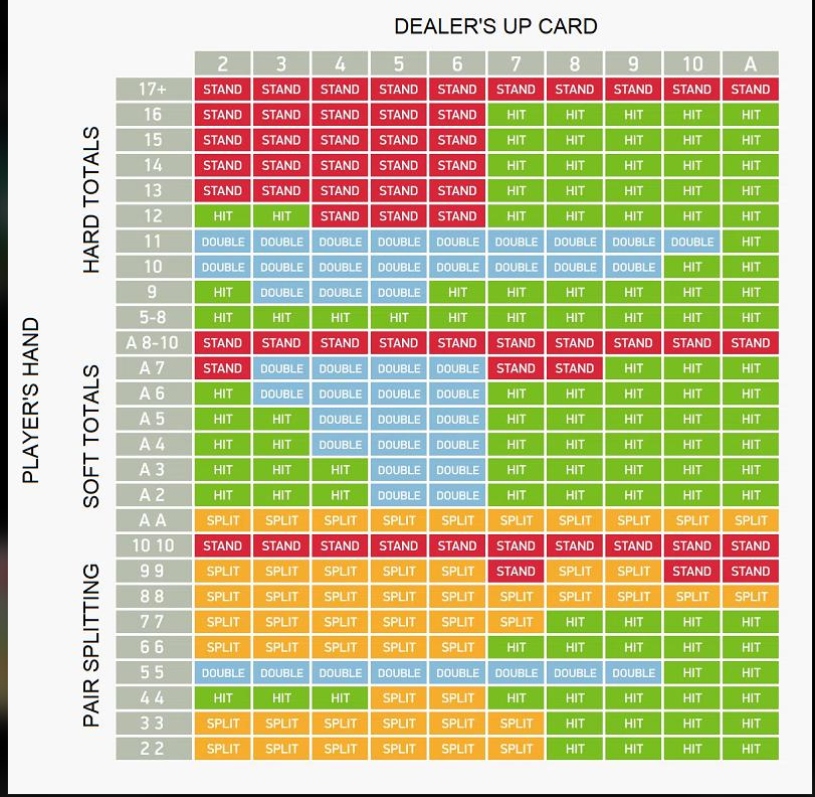
Compare your hand total on the left against the dealer's face-up card at the top to execute mathematically optimal decisions every round.
Hard Totals Rule
Stand on 12–16 if dealer shows 2–6. Hit 12–16 if dealer shows 7–Ace. Always hit 8 or lower; always double 10 and 11.
Soft Totals Rule
Never stand on Soft 13–17 (hit or double). Stand on Soft 19–20. Double Soft 18 against dealer 2–6; stand vs 7–8; hit vs 9–Ace.
Pair Splitting Rule
Always split Aces and 8s. Never split 5s (double them) or 10s (keep strong 20). Split 2s, 3s, 7s against dealer 2–7.
Master Blackjack on Our 3D Casino Simulator
Put your knowledge of card values, hand distributions, and basic strategy to the test on our free 3D browser simulator with authentic Vegas sound effects, 3:2 payouts, and multiplayer seating.
Frequently Asked Questions • How to Play Blackjack
What are the exact card values in blackjack?
Cards 2 through 10 are worth their pip face value. Face cards (Jack, Queen, King) are each worth 10 points. An Ace is worth either 1 point or 11 points, whichever benefits your hand total most without busting.
Do card suits matter or have different weights in blackjack?
No. Card suits (Spades, Hearts, Diamonds, Clubs) have zero weight or point hierarchy in standard blackjack. An 8 of Spades and an 8 of Hearts are identical in value. Suits only matter in optional specialty side bets like Perfect Pairs or Flush bonuses.
How does hand distribution work in blackjack?
Cards are distributed clockwise starting from First Base (seat to the dealer far left). Each seated player receives two cards face up. The dealer receives one card face up (the upcard) and one hidden card face down (the hole card).
What is the difference between a Hard and Soft hand in blackjack?
A soft hand contains an Ace counted as 11 without exceeding 21 (e.g. Ace-6 is Soft 17). It cannot bust on a single additional hit. A hard hand contains no Ace, or an Ace that must be valued at 1 to prevent busting (e.g. 10-6 or 9-Ace-5 is Hard 16).
Why should players never buy insurance?
Insurance pays 2:1 when the dealer shows an Ace and has a 10 underneath. However, only 30.7% of the shoe contains 10-value cards, resulting in a house advantage of over 7.4%. Basic strategy universally advises never buying insurance.